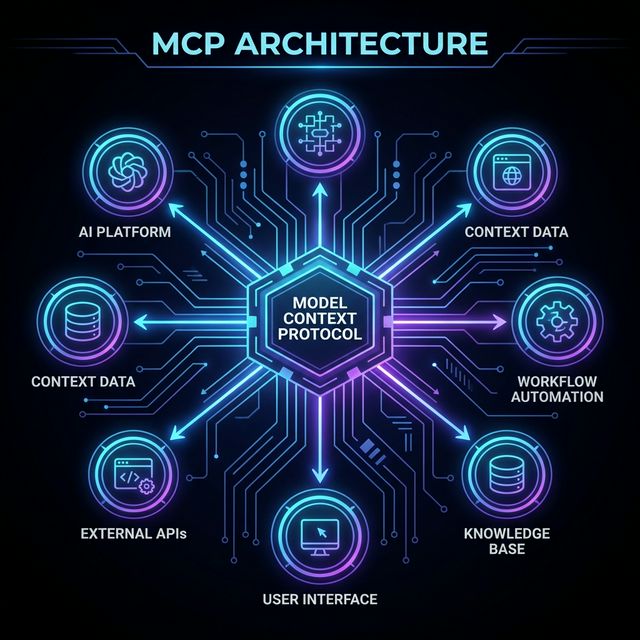
Model Context Protocol has become the standard bridge between AI development platforms and external tools. For n8n users, MCP represents something specific: the ability to give AI agents structured, real-time access to your automation environment instead of relying on approximations from training data.
What Model Context Protocol Actually Is
MCP is an open standard developed by Anthropic that standardises how AI models connect to external tools and data sources. Before MCP, every integration between an AI model and an external service required a custom adapter. MCP replaces that with a universal protocol. One connection standard that works across tools, models, and platforms. The analogy that circulates most often is USB-C for AI.
For n8n specifically, MCP enables AI agents to query node schemas, read documentation, search templates, validate configurations, and — with the right permissions — create, modify, and execute workflows directly.
How n8n Supports MCP in 2026
n8n's built-in MCP Server. As of early 2026, n8n offers instance-level MCP access that lets external AI clients connect to your n8n instance. You enable MCP at the instance level, choose which workflows to expose, and connect clients like Claude Desktop or Lovable. This approach is designed for exposing existing workflows to AI clients.
The MCP Client Tool node. n8n also includes a built-in MCP Client Tool node that allows n8n workflows to connect to external MCP servers. This turns n8n into an MCP client.
Third-party MCP servers for n8n. This is where ag8n sits. External MCP servers that give AI development platforms — Antigravity, Claude Desktop, Cursor, Windsurf — structured access to n8n's node ecosystem, documentation, and template library.
The Raw MCP Problem
Raw MCP access gives an AI agent structured data about n8n nodes. It can look up every property of every node, every operation, every schema. What it cannot do is understand how those pieces fit together in practice. The data is comprehensive. The contextual intelligence is missing.
The agent has every word in the dictionary. It does not know how to write a sentence.
How ag8n's Skill Pack Closes the Gap
ag8n ships with fourteen expert skills that load into Antigravity through its native progressive disclosure system. Each skill sits dormant until the agent determines it is relevant to the current task.
Workflow Architect encodes the design patterns that experienced n8n developers apply instinctively. Webhook-triggered processing pipelines. Scheduled data synchronisation jobs. API polling with conditional routing.
Expression Mastery handles the syntax gap. n8n expressions resemble JavaScript closely enough to fool a generalist model but deviate in ways that cause silent failures in production.
Node Expert addresses configuration depth. Display Options behaviour, credential handling, output data shapes that change based on operation type.
Validation Debugger enforces quality before deployment.
Privacy as Architecture
ag8n's MCP server is forked from czlonkowski/n8n-mcp with all telemetry subsystems removed at the fork level — not disabled via configuration toggle, but removed from the codebase entirely. No usage data is collected. No analytics are transmitted. No Docker dependencies.
Getting Started with MCP and n8n
Install the ag8n MCP server (Node.js, five minutes, no containers). Add the MCP configuration to Antigravity. Optionally add your n8n API key for full workflow management. The skill pack loads automatically.
£9.95. One-time purchase. No subscription. The entire package.
MCP Server + Expert Skills. Five Minutes to Install.
ag8n gives Antigravity structured access to 1,084 n8n nodes and teaches it how to use them. Privacy-first. Zero telemetry. £9.95.
Get ag8n — £9.95